
Last month we wrote about rhythm: the recurring financial motions that keep clarity from being an event. August was the test of whether that cadence holds when nothing is forcing it.
September asks something different of it.
Because September is the only month of the year that runs two clocks at once. One is counting down. There are roughly four months left to change how this year finishes. The other is counting up. Whatever you decide this fall about headcount, pricing, investment, and structure starts becoming real in January — and the work of deciding it begins now.
Most leadership teams run one of those clocks well. Fewer run both.

Why September Feels Different Than It Looks
On the calendar, September looks like a return to normal. The team is back. Q3 is closing. Demand is picking up. The natural instinct is to put your head down and execute.
But the operating reality is that September is the last month with room in it. By late October, Q4 execution takes the wheel. Board meetings, year-end pushes, customer deadlines, holiday schedules. Planning becomes something that happens in the margins of a busy quarter, usually in December, usually under time pressure. And a plan built under time pressure is almost always last year’s plan with a growth rate applied to it.
That is how companies end up with an annual plan nobody actually operates against. Not because the leadership team lacked judgment, but because the window to apply that judgment quietly closed while everyone was busy finishing the year.
September is where you still have the room to do it properly.
Clock One: What Can Still Change This Year
Four months is enough time to move some things and not others. Getting clear on which is which is the first useful act of the fall.
Some levers are still live. Collections timing and the cash position you carry into January. Discretionary spend. Pricing on new work. A hire that closes a capacity gap for Q4. Which work you take, and what that does to how the year finishes on margin.
Others are mostly settled. Revenue that depends on a long sales cycle. A cost structure change that takes a quarter to implement. Anything requiring a system change. Those decisions were made in the spring and summer, and pushing on them now mostly generates activity rather than outcomes.
Most year-end scrambles come from exactly that confusion. Teams spend October and November pressing hard on things that were already decided back in August, while the few levers that were genuinely still open go untouched.
The starting point is an honest landing zone. Given eight months of actuals and a realistic read on Q4, where does this year actually finish? Not the budget number. Not the number you would prefer to report. The number the data supports.
Once that is on the table, the conversation gets useful. If the honest landing zone is where you want it, the question becomes how to protect it through a noisy quarter. If it is not, you have four months to close the gap. That is a real amount of time, but only if you start with a real number.
Clock Two: Building Next Year From a Real Baseline
The second clock is the one that gets shortchanged.
Most annual plans get built one of two ways. Either they start from last year’s plan and get adjusted, or they start from a target and get worked backward until the math lands. Both produce a number. Neither produces a plan you can operate against.
A plan you can operate against starts from a baseline: what the business actually does today, at current pricing, current cost structure, current productivity. Margin by service line or product as it really is, not as it was modeled. Fixed costs as they will actually be next year, including the increases already committed. Cash conversion as it actually behaves.
From there, growth assumptions become testable. If the plan assumes twenty percent growth, you can ask what capacity that requires, what it costs to add, when it has to be in place, and what happens to cash in the months between the spend and the revenue. Those are answerable questions when the baseline is real. They are guesses when it is not.
This is where the work of the last several months pays off. Teams that have been closing on a predictable cadence, holding a rolling forecast, and working from one version of the numbers already have their baseline. They get to spend September on the decisions. Teams that do not have to spend September rebuilding the data — and by the time it is clean, the planning window has closed.
Where the Two Clocks Meet
The connection between them is cash, and it is the thing most plans handle last.
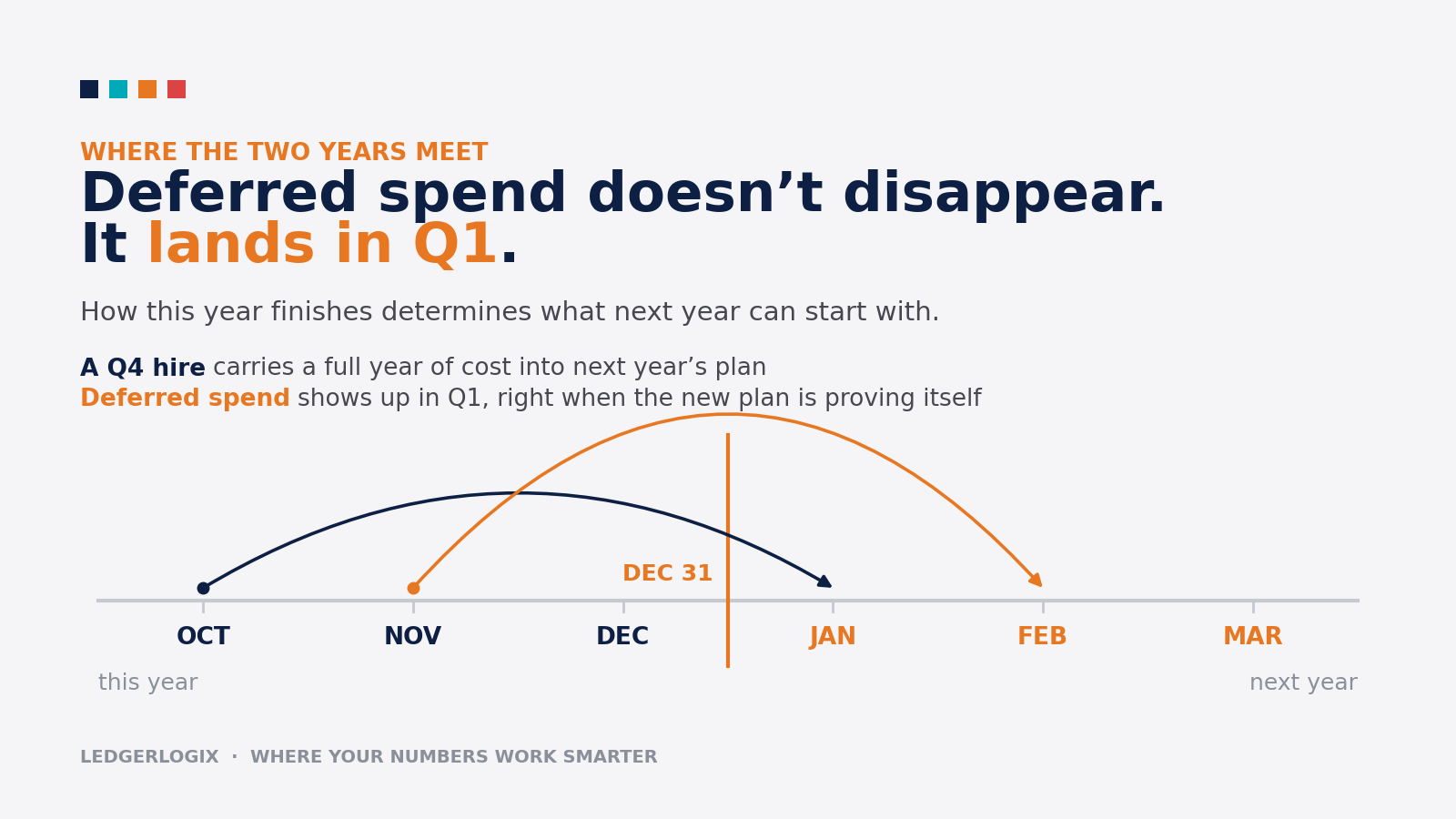
How this year finishes determines what next year can start with. A strong Q4 collection effort changes January’s investment capacity. A Q4 hire made in September carries a full year of cost into next year’s plan. Spend deferred out of this year does not disappear — it lands in Q1, usually in the same quarter the new plan is trying to prove itself.
Which is why running the two clocks separately produces plans that do not survive contact with the first quarter. The year-end push gets managed for this year’s number. The annual plan gets built for next year’s target. And nobody connects the cash between them.
One forward view that runs through the end of next year — a single view, not two documents — is what keeps that handoff clean. It is a modest piece of financial infrastructure, and it changes the quality of every decision made between now and January.

Planning Season Rewards the Prepared
When we look at the growth-stage companies that start a year with real clarity, the pattern is consistent. They were not faster in December. They were ready in September. Their numbers were current, so the planning conversation was about judgment instead of data cleanup. Their forward view already extended past year-end, so the two clocks were never actually separate.
Most leadership teams do not need to build that capability from scratch. They need someone to run the financial layer underneath it, reliably, so that when planning season opens the baseline is already there. That is the work LedgerLogix does.
If Your Planning Season Deserves a Baseline, Not a Blank Page
We work with leadership teams who want to walk into their annual planning conversation with real numbers underneath it. An honest read on how this year finishes. A baseline that reflects how the business actually operates. A cash view that carries across both years instead of stopping at December.
If it would be useful to look at where your baseline stands before planning season opens, we are glad to spend 30 minutes on it. No deck. No pitch. Just a directional read on what is in place and what might be worth tightening while there is still room to act.