
Understanding the Difference Between Bookkeeping, Controller Services, and CFO Strategy
Growth is exciting.
Revenue is climbing. Headcount expands. Sales increase. The business feels alive.
And yet something underneath starts to feel unstable.
Cash feels tighter than it should.
Financials arrive later than expected.
Leadership debates numbers instead of decisions.
This is the stage where most companies don’t fail because of strategy.
They break because the financial execution layer hasn’t evolved with the business.
More specifically — they break at the controller level.

The Finance Gap That Appears During Growth
In the early stage of a company, bookkeeping is enough.
You need:
- Transactions recorded
- Bills paid
- Payroll processed
- Basic reports generated
At $500K to $1M, that structure works.
But as revenue moves past $2M… $5M… $10M… the demands on your finance function change dramatically.
Now the business needs:
- Structured month-end close
- Accrual-based financials
- Department-level visibility
- Margin analysis
- Budget tracking
- Cash forecasting
- Clean reporting for investors or lenders
That shift is where tension begins.
Because bookkeeping handles activity.
Growth requires financial architecture.
What Actually Breaks First
When companies outgrow their financial structure, the symptoms are predictable.
- The Close Feels Reactive
Financials may be technically complete — but they aren’t delivered in a structured, repeatable 10–15 day window. Leadership waits. Decisions stall. Reporting lags behind operations.
- Revenue Is Up — But Cash Feels Constrained
Without disciplined revenue recognition, expense tracking, and forward-looking forecasting, growth can quietly strain liquidity.
The income statement looks healthy. The bank balance tells a different story.
- No One Owns the Financial Engine
Tasks are getting done.
But ownership of:
- Reporting integrity
- Variance analysis
- Process documentation
- Internal controls
Is unclear.
That lack of ownership creates friction — and friction slows momentum.
Controller vs. Bookkeeper vs. CFO: Understanding the Financial Stack
One of the biggest scaling mistakes companies make is assuming these roles are interchangeable.
They aren’t.
Each layer serves a different purpose in a growing organization.
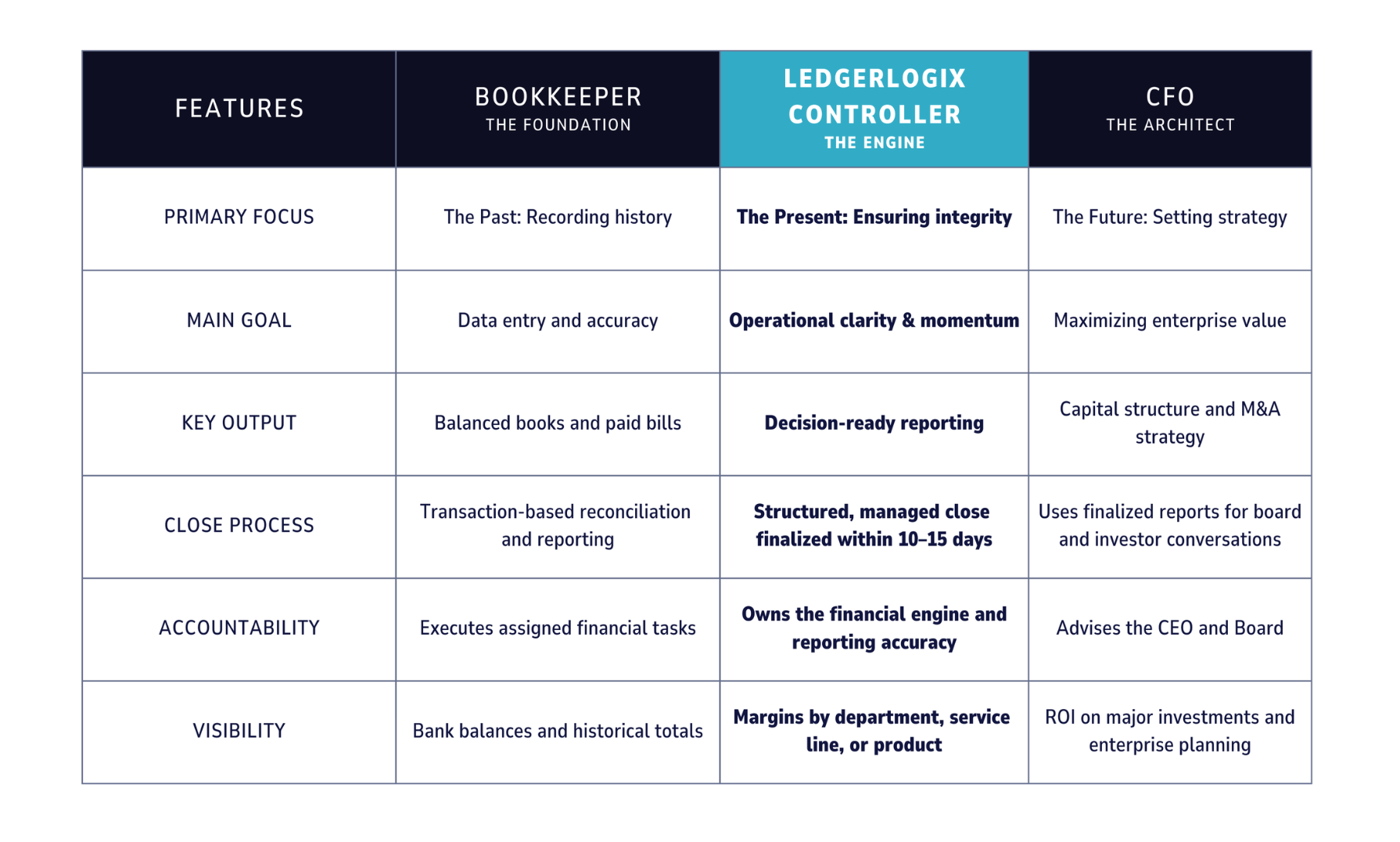
This isn’t about capability.
It’s about design.
A bookkeeper maintains records.
A controller builds the operating system.
A CFO uses that system to drive long-term strategy.
When companies skip the controller layer, they attempt to build strategic insight on reporting that hasn’t been operationally structured.
Execution must come before elevation.
Why the Controller Layer Breaks Between $5M and $15M
This is the growth inflection zone.
At this stage:
- Transactions multiply
- Systems become more complex
- Payroll expands
- Pricing decisions carry more weight
- Investors want deeper reporting
- Department leaders want financial visibility
Yet many businesses are still operating with:
- A senior bookkeeper
- An internal accountant wearing too many hats
- Or compliance-only outsourced support
The company has evolved.
The finance structure hasn’t.
That mismatch is where stress compounds.
The Real Cost of Skipping the Controller Seat
When the controller function is underbuilt, the damage rarely appears as one dramatic event.
It shows up as erosion:
- Margin leakage
- Over hiring
- Poor pricing decisions
- Cash surprises
- Investor distrust
- Founder fatigue
Growth continues — but it feels heavier than it should.
That weight is operational inefficiency.
What Strong Controller Leadership Looks Like
When the controller function is structured correctly, the shift is immediate.
- Financials close consistently within 10–15 days
- Leadership trusts the numbers
- Department heads understand their spending
- Variances are explained clearly
- Cash forecasts are reliable
- Board conversations feel controlled
Instead of reacting to financial surprises, leadership operates proactively.
That stability allows strategy to actually stick.
A Simple Diagnostic
If you’re unsure whether your business has outgrown its current structure, ask:
- Are our financials finalized within two weeks every month — consistently?
- Do we have visibility into margins by department or product?
- Can we forecast cash 90 days out with confidence?
- Are budget variances explained clearly and quickly?
- Does leadership fully trust the numbers being reviewed?
If multiple answers feel uncertain, the controller seat is likely underbuilt.
Not because anyone is failing.
Because the business has grown.
Growth Requires Infrastructure
Revenue growth is one form of progress.
Operational maturity is another.
Companies that scale sustainably invest in the layer that makes strategy executable. They don't just pursue advisory insight - they build the financial infrastructure that supports it.
The controller role is not a luxury upgrade.
It's the stabilizer.
Strengthen that layer, and everything above it - strategy, capital planning, enterprise value - becomes stronger.
If your company is growing and finance feels reactive instead of controlled, it may not be a strategy issue.
It may simply be time to strengthen the execution engine behind your growth.
At LedgerLogix, we partner with growth-stage companies to implement structured, outsourced controller services that create clarity, accountability, and forward momentum - without the overhead of building a full internal department.
If you'd like to evaluate whether your controller layer is built for scale, we welcome that conversation.