
Most businesses aren’t making bad decisions—they’re making them too late. Learn how financial operations and controller-led support improve decision timing and drive scalable growth.

Growth-stage businesses rarely struggle because of a lack of effort.
They have teams in place. Revenue is coming in. Operations are moving. On the surface, things look stable—even successful.
But underneath that momentum, there’s often a quieter issue developing:
decisions are being made too late to be effective.
Not because leadership is inattentive. Not because the business lacks data.But because the financial layer needed to support timely, confident decision-making isn’t fully in place.
The Timing Problem Most Teams Don’t See
Most leadership teams don’t feel like they’re waiting.
Decisions are being made. Conversations are happening. Progress is being tracked.
But when we step into businesses at this stage, we often find the issue isn’t whether decisions are being made—
it’s whether they’re being made early enough to actually change the outcome.
That distinction is subtle.
And it’s exactly where performance starts to drift.
Why this isn’t obvious until it’s expensive
At this stage, most businesses aren’t ignoring their financials—they’re reviewing them.
Monthly reports are delivered. Books are clean. Performance is discussed.
But the gap isn’t in having the information. It’s in how quickly that information can be turned into action.
The delay shows up in ways that don’t immediately raise concern:
• Hiring decisions that lag behind demand
• Pricing adjustments that follow margin pressure instead of preventing it
• Cash flow planning that reacts instead of anticipates
• Leadership teams revisiting the same questions month after month
Individually, these don’t feel urgent.
But collectively, they create friction that slows the business down—often without being immediately obvious.

The Compounding Effect of Delayed Decisions
At $5M+, timing becomes a multiplier. Every decision impacts:
- more people
- more clients
- more financial exposure
So when decisions are delayed—even slightly—the impact is larger and harder to unwind.
What looks like a small delay becomes:
- missed margin opportunities
- slower response to market changes
- reduced clarity in leadership conversations
At this stage, timing isn’t just operational—it’s financial. A 30-day delay in a pricing adjustment—or a missed margin issue over a single quarter—can quietly erode thousands in profit that can’t be recovered.
These aren’t dramatic failures. They’re timing gaps.
Why This Happens (Even in Well-Run Companies)
This isn’t a leadership issue. It’s a structural one.
Most companies at this level have:
✔ clean books
✔ reliable reporting
But they’re missing the layer between:
👉 financial reporting
👉 real-time decision-making
Many companies try to solve this with higher-level strategy.
But strategy doesn’t fix timing—execution does.
Without a financial operations layer embedded into day-to-day decisions, even the right strategy arrives too late to matter.
That’s where the breakdown occurs.
What This Looks Like in Practice
This gap isn’t solved by more reports or occasional advisory.
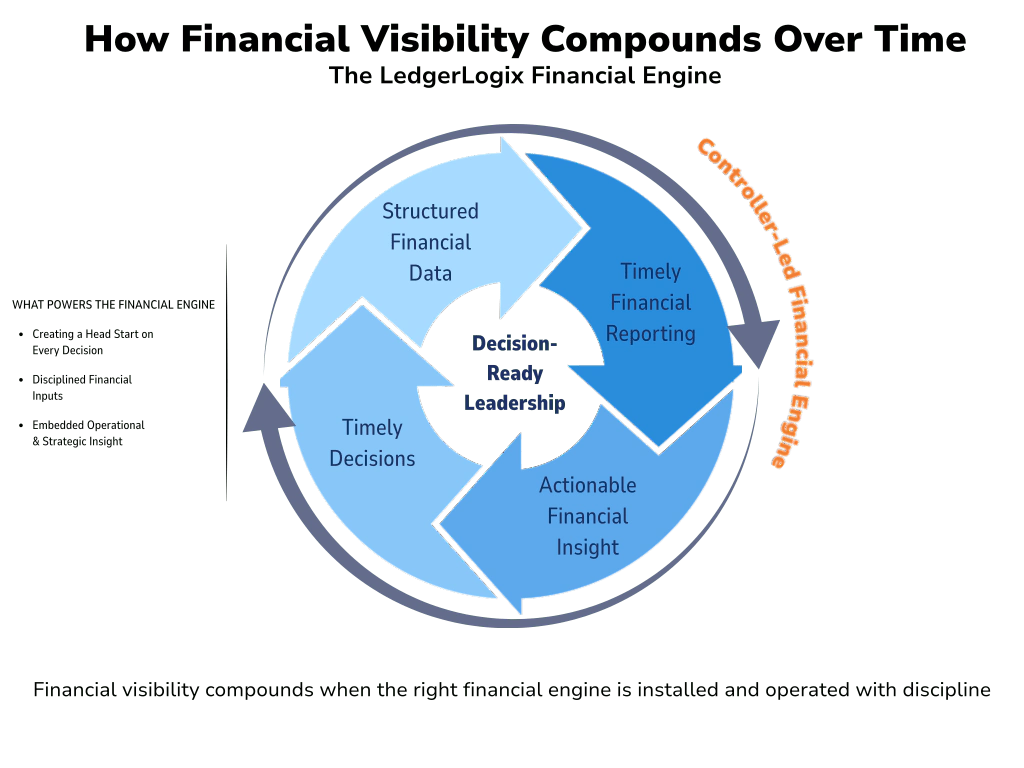
It’s solved by putting a controller-led financial engine in place.
At LedgerLogix, our Controller doesn’t operate as a traditional reporting function—they operate as the core of that engine.
A financial engine ensures:
- insights arrive early enough to influence decisions
- financial data is continuously translated into action
- leadership has forward visibility—not just historical context
- financial strategy is embedded into day-to-day operations
A controller doesn’t just deliver a report—they deliver a head start.
While bookkeeping ensures data accuracy, the LedgerLogix Controller-led financial engine ensures insights show up in time to shape outcomes, not just record them.
Closing Thought
The businesses that scale well aren’t just good at making decisions.
They’re making them early enough to matter, with the right financial engine behind them.
If your team is still relying on after-the-fact reporting to make forward-looking decisions, it may be time to rethink how your financial operations are structured to support growth.